

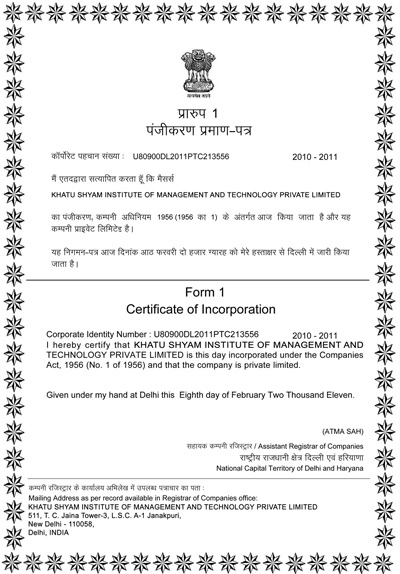
 National Registrar Ministry of Corporate (Govt. of India).
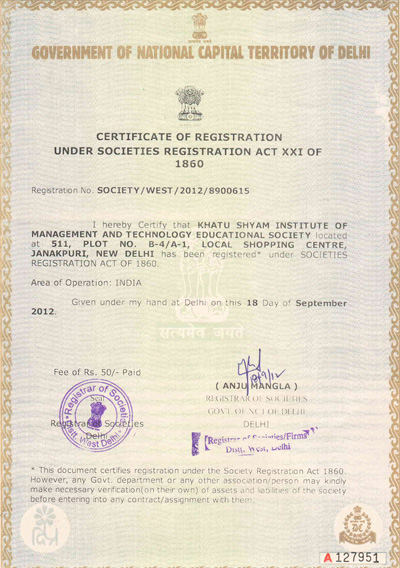 Registrar By NCT, Govt. of Delhi.
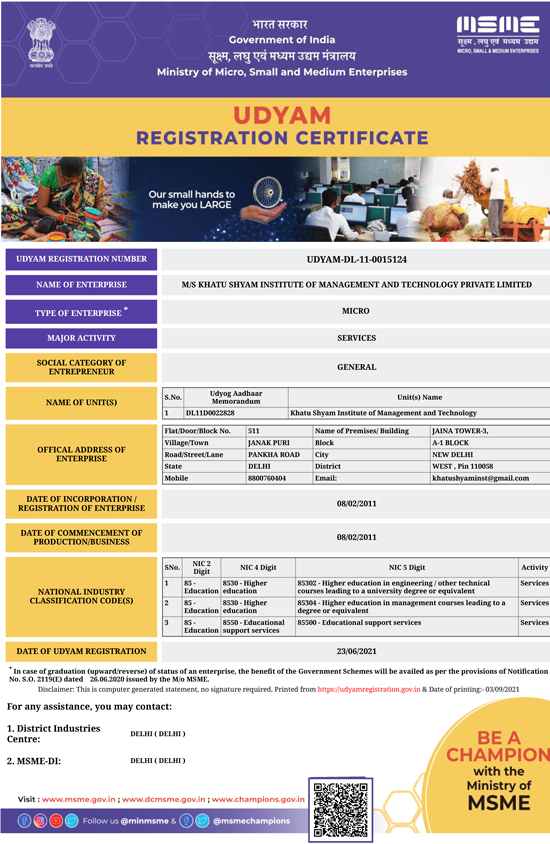 Register By Ministry of MSME, Govt. of India
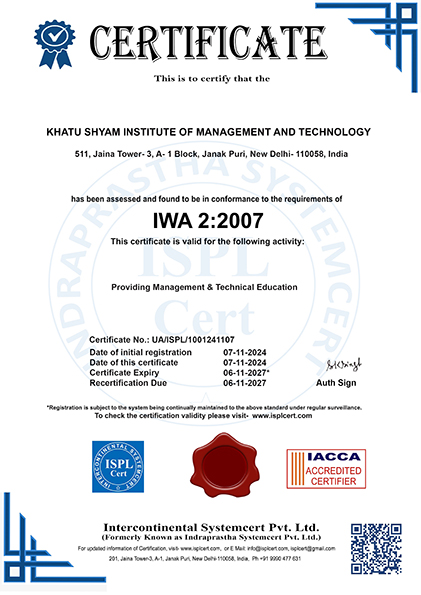 WA 2:2007 Certified By Indraprastha SystemCert Pvt.Ltd is Accredited By Integrated Accreditation Centre For Certification (IACCA) http://www.www.iacca.in
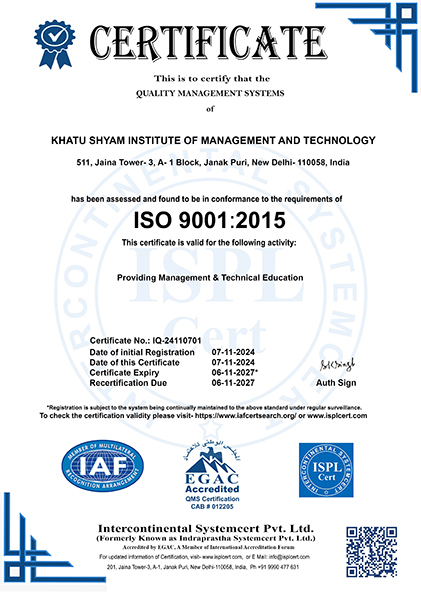 An ISO 9001-2015 Certified By Indraprastha SystemCert Pvt.Ltd is Accredited By Emirates International Accreditation Center (EIAC) https://www.eiac.gov.ae
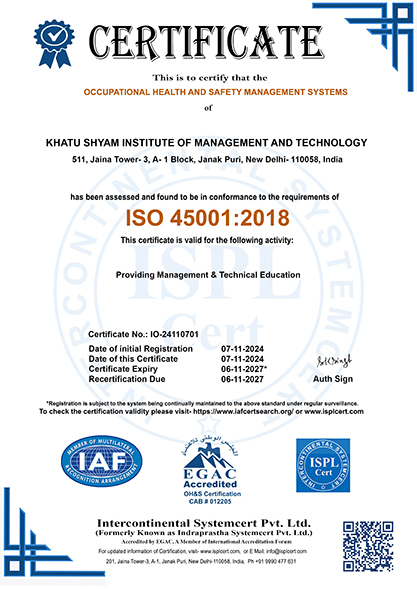 An ISO 45001:2018 Certified By Innovative SystemCert Pvt.Ltd is Accredited By Egyptian Accreditation Council, (EGAC) http://www.egac.gov.eg
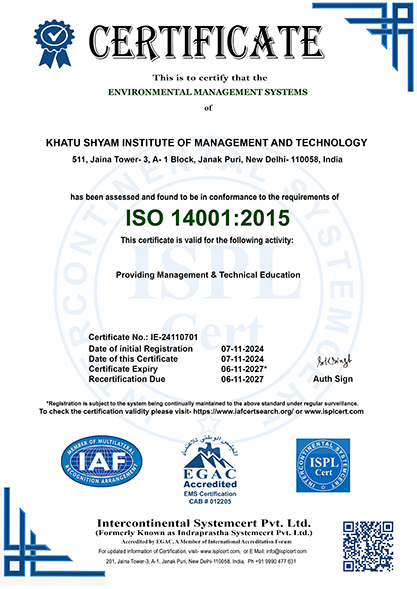 An ISO 14001:2015 Certified By Innovative SystemCert Pvt.Ltd is Accredited By Egyptian Accreditation Council, (EGAC) http://www.egac.gov.eg
Bachelor Program in Electronics and Communication Engineering for Working Professionals
Khatu Shyam Institute of Management & Technology (KSIMT) offers a Bachelor Program in Electronics and Communication Engineering (BE/BTech) through Distance, Online, Correspondence and Work-Integrated learning for eligible working professionals.
The program provides structured theoretical learning across electronics, electrical fundamentals, analog and digital electronics, signals and systems, communication systems, microprocessors, embedded systems, VLSI, digital signal processing, antennas, microwave engineering and optical communication.
It is designed for eligible professionals who want to continue education while managing employment, shift duties, technical responsibilities, projects or overseas work.
Eligible professionals across India, UAE, Dubai, Kuwait, Qatar, Oman, Saudi Arabia, Bahrain and other overseas locations can enquire.
KSIMT operates under the guidelines of the Government of Delhi and Government of India.
Work + Study = Success
Why Choose Electronics and Communication Engineering at KSIMT?
Electronics and Communication Engineering connects electronic systems with modern communication technologies.
The program is structured for experienced professionals who need flexible theoretical education without following a regular daily campus schedule.
Program Highlights
Distance, Online & Correspondence learning
Work-Integrated education model
100% theoretical study
Digital e-books
Student Login after admission
Digital ID Card after admission
No regular classroom attendance
No regular campus dependency
No regular laboratory attendance under the theoretical model
Flexible learning alongside employment
Applicable theoretical examinations and assignments
Examination assignment submission by courier only
India and overseas accessibility
Human student support
Who Should Explore This ECE Bachelor Program?
The program primarily focuses on eligible experienced professionals working in Electronics, Communication and related technical environments.
Relevant Professional Profiles May Include
Electronics Technicians
Electronics Supervisors
Telecom Professionals
Communication System Personnel
Electronics Maintenance Personnel
Network Support Personnel
Industrial Electronics Professionals
Instrumentation Personnel
Embedded System Personnel
Electronic Manufacturing Personnel
Technical Support Professionals
Communication Equipment Personnel
Experienced Engineering Professionals
Program eligibility depends on previous education, relevant professional experience and applicable admission requirements.
Eligibility for Bachelor Program in Electronics and Communication Engineering
Regular Entry
Qualification: 12th Grade with PCM – Physics, Chemistry and Mathematics
Duration: 4 Years
Candidates must also meet applicable KSIMT admission and relevant professional-experience requirements.
Lateral Entry
Qualification: Applicable 3-Year Engineering Diploma in a relevant field
Duration: 3 Years
Lateral Entry depends on previous technical qualification, relevant field, professional experience and applicable document verification.
Working Professional Requirement
KSIMT primarily focuses on experienced working professionals.
Candidates should have 3 or more years of relevant professional experience, with previous qualification and professional background appropriately aligned with the selected program.
Fresh candidates without applicable professional experience are not eligible under the established working-professional admission model.
Government employees should obtain applicable departmental permission or NOC wherever required.
Program Duration
Regular Entry: 4 Years
Lateral Entry: 3 Years for eligible Engineering Diploma holders
Final entry level is determined after applicable qualification, professional experience and document review.
Bachelor in Electronics and Communication Engineering Syllabus
The program includes 28 theoretical subjects across four years, with seven subjects in each year.
First Year
Engineering Mathematics I
Engineering Physics
Engineering Chemistry
Basic Electrical Engineering
Engineering Mechanics
Computer Programming
Environmental Science
Second Year
Engineering Mathematics II
Digital Electronics
Network Analysis and Synthesis
Signals and Systems
Electromagnetic Field Theory
Analog Electronics
Data Structures and Algorithms
Third Year
Engineering Mathematics III
Communication Systems
Microprocessors and Microcontrollers
Control Systems Engineering
Electronic Devices and Circuits
VLSI Design
Digital Signal Processing
Fourth Year
Engineering Mathematics IV
Optical Fiber Communications
Antenna and Wave Propagation
Embedded Systems
Microwave Engineering
Optical Communications and Networking
Industrial Electronics
The current live KSIMT page lists these 28 subjects across four years.
What Will You Study?
The program develops theoretical knowledge from fundamental Engineering concepts to advanced Electronics and Communication subjects.
Major Learning Areas
Engineering Mathematics
Electrical Engineering Fundamentals
Electronics
Analog Electronics
Digital Electronics
Network Analysis
Signals and Systems
Electromagnetic Fields
Communication Systems
Microprocessors
Microcontrollers
Control Systems
Electronic Devices
VLSI
Digital Signal Processing
Optical Fiber Communication
Antennas
Embedded Systems
Microwave Engineering
Industrial Electronics
Analog & Digital Electronics
Students develop theoretical understanding of analog and digital electronic technologies.
Applicable areas include:
Electronic devices
Electronic circuits
Analog Electronics
Digital Electronics
Electronic system concepts
Circuit behaviour
Industrial Electronics
These subjects provide an important foundation for advanced communication and embedded technologies.
Network Analysis, Signals & Systems
Network Analysis and Signals and Systems develop theoretical understanding of electrical and electronic networks and signal behaviour.
Students explore applicable concepts related to:
Network theory
Signal representation
System behaviour
Electrical networks
Signal characteristics
Applicable mathematical concepts
Communication Systems
Communication Systems forms a major part of the ECE program.
Students develop theoretical understanding across:
Communication fundamentals
Signal transmission
Analog and digital communication concepts
Communication channels
Transmission principles
Communication-system fundamentals
Microprocessors & Microcontrollers
Modern electronic and communication systems frequently use programmable electronic technologies.
The program includes theoretical learning across:
Microprocessor fundamentals
Microcontroller concepts
Processor architecture
Digital interfacing concepts
Programmable systems
Applicable electronic control concepts
Digital Signal Processing
Digital Signal Processing introduces theoretical methods used to represent, analyse and process signals digitally.
Students explore applicable concepts involving:
Digital signals
Signal processing
Sampling concepts
Digital system principles
Signal-analysis fundamentals
VLSI Design
VLSI Design introduces theoretical concepts related to highly integrated electronic circuits and semiconductor-based systems.
Students receive structured theoretical exposure to applicable VLSI concepts relevant to modern electronic technologies.
Embedded Systems
Embedded Systems combines electronic hardware and programmable control concepts.
Students develop theoretical understanding of:
Embedded system architecture
Microcontroller-based systems
Hardware-software interaction concepts
Electronic control systems
Embedded technology fundamentals
Antenna & Wave Propagation
Students study theoretical concepts associated with antennas and the propagation of electromagnetic waves.
Applicable learning includes:
Antenna fundamentals
Electromagnetic-wave concepts
Radiation principles
Wave propagation
Communication applications
Microwave Engineering
Microwave Engineering introduces theoretical concepts associated with high-frequency electronic and communication systems.
The program covers applicable principles related to microwave technologies, transmission and communication applications.
Optical Fiber Communication
Optical communication is an important part of modern communication infrastructure.
Students study theoretical concepts across:
Optical fibers
Optical transmission
Fiber communication
Optical networks
Communication-system concepts
Control Systems Engineering
Control Systems Engineering provides theoretical understanding of how Engineering systems can be monitored and controlled.
Students explore applicable concepts related to:
System response
Feedback
Control principles
System stability concepts
Electronic control
100% Theoretical Learning Through Digital E-Books
KSIMT follows a theoretical education model.
Applicable study material is provided digitally through e-books according to the program and subject structure.
Learning Model
Digital e-books
Subject-wise theoretical study
Flexible self-study
No regular classroom attendance
No regular laboratory attendance
No regular campus dependency
Study alongside employment
Applicable academic guidance
Student Login & Digital ID Card After Admission
After applicable admission formalities are completed and admission is confirmed, students receive applicable student access.
After Admission Confirmation
Students receive:
Student Login
Digital ID Card
Applicable digital e-book access
Program and academic information
Applicable examination information
Student-support access
Examination & Assignment Process
The Bachelor Program in Electronics and Communication Engineering follows a theoretical examination and assignment-based academic process according to applicable KSIMT requirements.
Students receive applicable:
Examination schedule
Examination instructions
Theory-based question papers
Assignment requirements
Subject-wise academic instructions
Submission instructions
Examination Assignment Submission by Courier
Applicable completed examination assignments or answer submissions must be submitted to KSIMT by courier only according to the communicated examination instructions and submission timeline.
Students should:
Complete applicable theoretical assignments or answers.
Follow the prescribed format and academic instructions.
Prepare the required submission documents.
Send the completed submission to KSIMT by courier.
Retain applicable courier receipt or tracking information.
Complete submission within the communicated deadline.
Online or digital examination assignment submission should not be assumed unless KSIMT officially changes the applicable procedure.
Examination Result
After applicable submissions are received and evaluated according to academic requirements, the Examination Result is processed according to the applicable examination cycle.
Students should follow official KSIMT communication regarding result information.
Electronics & Communication Engineering for Working Professionals in India
Eligible professionals across India can explore the program while continuing relevant employment.
The program may be relevant to experienced professionals working across:
Electronics
Telecommunications
Communication Systems
Industrial Electronics
Electronics Maintenance
Embedded Systems
Instrumentation
Electronics Manufacturing
Network Support
Technical Services
Industrial Operations
Program selection should remain relevant to previous education and professional experience.
Electronics & Communication Engineering for UAE & Dubai Professionals
Eligible professionals working in UAE and Dubai can explore the Bachelor Program remotely.
The flexible theoretical learning structure can help professionals manage education around shift duties, technical responsibilities, projects and overseas employment.
UAE & Dubai Student Support May Include
Eligibility review
Remote admission guidance
Student Login after admission
Digital ID Card
Digital e-book access
Examination and assignment guidance
Examination Result support
Academic documentation guidance
Verification support
Available attestation guidance
Human student support
Applicable completed examination assignments or answer submissions are submitted to KSIMT by courier only according to applicable instructions.
Electronics & Communication Engineering for Saudi Arabia, Kuwait, Qatar, Oman & Bahrain
Eligible Electronics and Communication professionals working across Saudi Arabia, Kuwait, Qatar, Oman and Bahrain can also enquire.
The flexible theoretical learning structure allows applicable education to be managed alongside overseas employment.
Eligible professionals in other overseas locations can also enquire.
Course Fee
Total Program Fee: 65,500 (INR)
The current live page lists the total course fee as 65,500 INR.
Applicable Fee Includes
Admission Fee
Digital Study Material
Examination Fee
Digital ID Card
Applicable Taxes
Payment Options
One-time payment
Applicable EMI options
Authorised KSIMT payment methods
Students should make payments only through authorised KSIMT channels and retain applicable payment records.
Admission Process
Step 1 – Share Your Profile
Provide previous education, relevant professional experience, current job profile and location.
Step 2 – Eligibility Review
The candidate profile is reviewed according to applicable Electronics and Communication Engineering admission requirements.
Step 3 – Entry-Level Confirmation
Regular or Lateral Entry is determined according to previous qualification, relevant professional experience and applicable requirements.
Step 4 – Submit Documents
Submit applicable educational, professional and identity documents.
Step 5 – Complete Admission Formalities
Complete applicable documentation and payment requirements.
Step 6 – Receive Student Access
After admission confirmation, receive the Student Login, Digital ID Card and applicable digital e-book access.
Step 7 – Begin Theoretical Learning
Begin subject-wise theoretical study according to applicable academic requirements.
Program Information & Intended Use
Candidates should understand the program structure, theoretical education model, eligibility and intended requirements before admission.
KSIMT operates under the guidelines of the Government of Delhi and Government of India.
Requirements can differ between private employers, government departments, educational institutions, professional bodies and overseas authorities.
Candidates requiring the program for a specific employment, promotion, government, further-study, licensing, immigration or overseas purpose should verify applicable requirements with the concerned organisation or authority before admission.
Frequently Asked Questions
What is the Bachelor Program in Electronics and Communication Engineering at KSIMT?
It is a theoretical Bachelor Program covering Electronics and Communication Engineering subjects through a flexible Distance, Online, Correspondence and Work-Integrated learning model.
Is this program designed for working professionals?
Yes. The program primarily focuses on eligible experienced professionals working in Electronics, Communication and related technical fields.
What is the duration?
The standard duration is 4 years for Regular Entry and 3 years for eligible Lateral Entry candidates.
Who is eligible for Regular Entry?
The current program structure lists 12th Grade with Physics, Chemistry and Mathematics (PCM) for Regular Entry, subject to applicable admission requirements.
Who is eligible for Lateral Entry?
The current program structure lists an applicable 3-Year Engineering Diploma for Lateral Entry, subject to relevant-field and admission requirements.
Is relevant work experience required?
Yes. Under the KSIMT working-professional admission model, candidates should have 3 or more years of relevant professional experience.
Is the program theoretical?
Yes. The program follows a 100% theoretical education model supported through digital e-books.
Is regular classroom attendance required?
No regular daily classroom attendance is required under the flexible theoretical learning model.
Are regular laboratory sessions required?
No regular laboratory attendance forms part of the theoretical education model.
How many subjects are included?
The current syllabus contains 28 theoretical subjects across four years, with seven subjects in each year.
Does a student receive a Student Login?
Yes. After admission confirmation, the student receives an applicable Student Login.
Does a student receive an ID Card?
Yes. A Digital ID Card is provided after admission confirmation.
How is study material provided?
Applicable theoretical study material is provided digitally through e-books.
How are examination assignments submitted?
Applicable completed examination assignments or answer submissions are submitted to KSIMT by courier only according to the communicated examination instructions and deadline.
Can examination assignments be submitted online?
Under the current procedure, applicable examination assignments or answer submissions are submitted by courier only.
What is the total program fee?
The total program fee is 65,500 (INR).
Can UAE and Dubai professionals enquire?
Yes. Eligible professionals working in UAE and Dubai can enquire remotely.
Can professionals in Saudi Arabia, Kuwait, Qatar, Oman and Bahrain enquire?
Yes. Eligible professionals across these Gulf countries can enquire remotely.
Continue Working While Building Electronics & Communication Engineering Knowledge
The Bachelor Program in Electronics and Communication Engineering provides structured theoretical learning across electronics, communication systems, signal processing, microprocessors, embedded systems, VLSI, antennas, microwave technology and optical communication for eligible experienced professionals.
With 28 theoretical subjects, digital e-books, Student Login, Digital ID Card, flexible learning and structured examination support, eligible professionals can continue applicable education while managing employment across India, UAE, Dubai, Kuwait, Qatar, Oman, Saudi Arabia, Bahrain and other overseas locations.
Khatu Shyam Institute of Management & Technology (KSIMT)
511, Jaina Tower-3, A-1 Block, Janak Puri, New Delhi – 110058
Call / WhatsApp: +91 9953631363
Website: www.ksimt.ac.in
Email: khatushyaminst@ksimt.ac.in
Work + Study = Success
Course Offered By : KSIMT under autonomous mode through distance education
Request a Callback
Admission Guidance for Working Professionals Work experience preferred (3+ years recommended)
